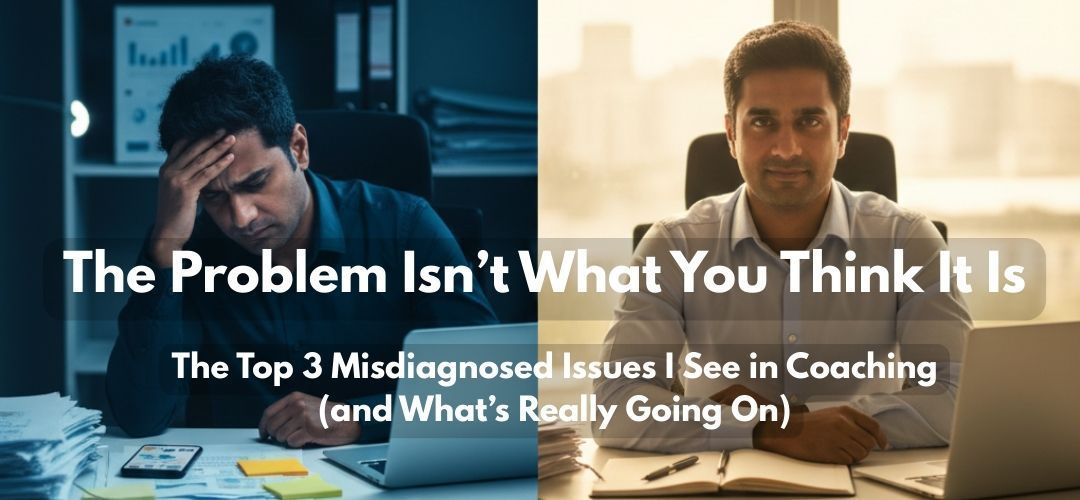
The Top 3 Misdiagnosed Issues I See in Coaching (and What’s Really Going On)
Most people come to coaching thinking they know exactly what’s wrong.
“My marriage is failing.”
“My team is underperforming.”
“I don’t know what I want anymore.”
They say it with certainty.
With frustration.
With exhaustion.
And at first glance, those diagnoses make sense.
But here’s what I’ve learned — both in my own life and in working with leaders, executives, and individuals in transition:
The problem we think we have is rarely the actual problem.
More often than not, we’re misdiagnosing the root cause.
And when you misdiagnose the problem, you try to fix the wrong thing.
Let’s talk about three of the most common ones I see.
1. “My Relationship Is Failing.”
This doesn’t just show up in marriages.
It shows up in business partnerships.
On leadership teams.
Between managers and employees.
Between parents and adult children.
The surface issue is usually framed as:
“They don’t show up.”
“They don’t help.”
“They don’t understand me.”
“They aren’t stepping up.”
But when we dig deeper, something else often emerges.
Unclear expectations.
Unspoken resentment.
Over-functioning.
Control masked as responsibility.
Many high-capacity people believe that the more they take on, the better things will run. The more they manage, the smoother everything will be.
And at first? It works.
Until it doesn’t.
Because when you carry everything, you unintentionally train everyone around you not to.
Then you feel abandoned.
Unappreciated.
Unsupported.
And the resentment builds.
Not because the other person is incapable — but because the dynamic was never recalibrated.
The shift isn’t about “saving the relationship.”
It’s about learning to:
• Communicate expectations clearly
• Stop over-functioning
• Allow others to own their responsibilities
• Release the illusion that control equals safety
That’s not easy work.
But it’s honest work.
2. “My Business Isn’t Growing Because of My People.”
This one shows up in founders and executives constantly.
“The team just isn’t strong enough.”
“They don’t think strategically.”
“They’re not executing.”
“No one owns anything.”
It feels like a people problem.
But when we slow down and examine the structure, we usually find something else.
Unclear roles.
Too many priorities.
No defined metrics.
Leaders still operating as doers instead of leaders.
If expectations aren’t written, defined, and measured, frustration becomes the default management style.
If the leader is still in the weeds, the team never learns to lead.
If everyone has 14 “top priorities,” no one has one clear focus.
This is where emotions shift dramatically in coaching.
Leaders often come in hot — frustrated, disappointed, defensive.
But the moment they see how their structure (or lack of it) is contributing to the dysfunction?
The energy changes.
Because now it’s solvable.
When roles are clarified, priorities narrowed, and accountability built into process — the need for micromanagement disappears.
And so does a lot of the resentment.
3. “I Don’t Know What I Want.”
This one sounds neutral.
Even self-aware.
But most of the time, it’s not confusion.
It’s identity.
You’ve been one version of yourself for so long —
The strong one.
The capable one.
The reliable one.
The hustler.
The peacemaker.
The provider.
That you can’t imagine being anything else.
Even if that version is exhausting you.
Even if that version no longer fits your life.
Life changes.
When you’re single, one structure works.
When you marry, it needs to adjust.
When you have kids, it must adjust again.
When you get promoted or build a company, it shifts again.
But many of us keep operating from the same identity that got us here.
We forget:
What got you here won’t take you there.
So instead of admitting you’re afraid to evolve, you say,
“I don’t know what I want.”
Because wanting something different requires:
• Risk
• Visibility
• Judgment
• Letting go of a familiar identity
And that’s vulnerable.
But the moment you acknowledge that fear instead of hiding behind confusion?
Clarity begins.
The Hardest Truth (And the Most Empowering One)
The common denominator in all three of these misdiagnoses?
You.
Not in a blame-filled way.
In an ownership-filled way.
The relationship dynamic shifts when you shift.
The business structure changes when you change it.
The identity evolves when you give yourself permission to grow.
At first, that realization feels uncomfortable.
Exposing.
Humbling.
Clients often try to justify their position.
Defend their behavior.
Explain why they’re right.
And then — if they’re willing — something softer takes over.
Curiosity.
Relief.
Because if you’re contributing to the pattern…
You’re also capable of breaking it.
And that’s the real power.
Not fixing everyone else.
Not waiting for circumstances to improve.
But seeing clearly where you’ve been stuck — and choosing differently.
That’s what coaching really is.
Not advice.
Not hand-holding.
But strategic reflection that helps you see what you couldn’t see alone.
If you’re reading this and thinking,
“Okay… that one hit.”
Good.
That’s not shame.
That’s awareness.
And awareness is the beginning of movement.
If you’re ready to stop misdiagnosing your life or leadership and start making aligned, intentional shifts — schedule a
clarity session.
Sometimes the only thing standing between you and forward motion is the courage to look at the real problem.