For nearly 20 years of my life, I struggled with my weight.
Not in the way people often assume. I wasn’t obese. I wasn’t medically “overweight.”
I was just… chubby. And I didn’t look like the other girls.
As a teenager, I followed what we were taught was “healthy” according to the traditional U.S. food pyramid. I leaned heavily into
whole grains, breads, rice, and cheese. Protein came in small portions—some chicken, a few eggs—but carbohydrates were the foundation of my diet.
That was the guidance. That was the food pyramid.
And yet, my body didn’t respond the way it was supposed to.
Now, with the release of
RealFood.gov and updated U.S. food guidance, the government is finally acknowledging what science—and many bodies—have been saying for years:
the old food pyramid didn’t work for everyone.
What Is RealFood.gov and Why the Food Pyramid Changed
RealFood.gov reflects a major shift away from the outdated, carb-heavy food pyramid that dominated U.S. nutrition guidelines for decades.
This change is rooted in growing scientific evidence showing that:
- Diets overly focused on carbohydrates—especially refined grains—can lead to insulin resistance and metabolic dysfunction
- Adequate
protein intake supports muscle mass, metabolic health, and satiety
- Healthy fats play a vital role in hormone balance and brain function
- Blood sugar stability is essential for long-term health, weight regulation, and emotional well-being
The new approach emphasizes
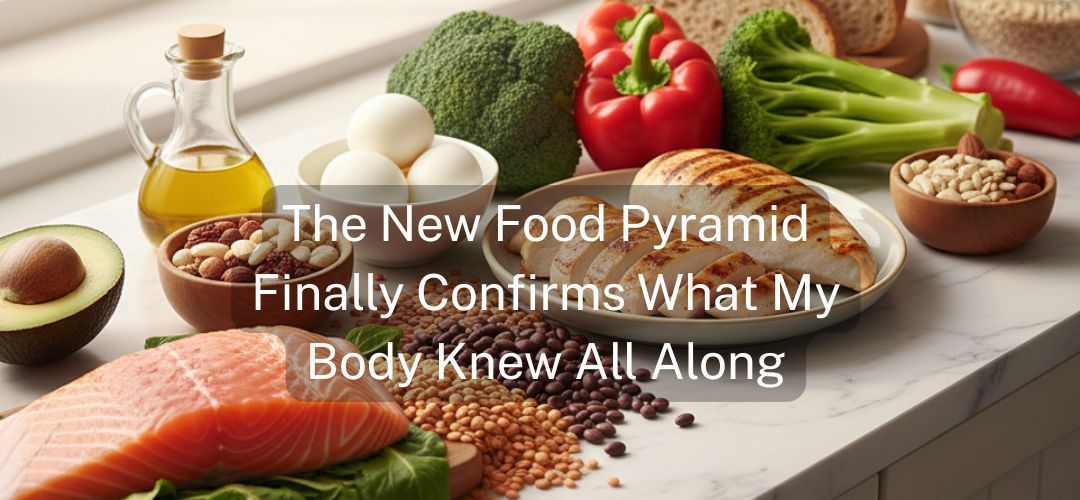
real, whole foods, prioritizing protein, vegetables, healthy fats, and minimally processed carbohydrates—rather than stacking the base of the diet with bread and grains.
In short, the food pyramid was overdue for a correction.
When “Healthy Eating” Led to an Unhealthy Relationship with Food
As a teenager, I didn’t know why my body felt different—but I felt it deeply.
Trying to control my weight eventually turned into something darker. I never openly talked about it, and I denied it when others tried to bring it up, but the truth is—I developed an eating disorder.
I stopped eating after 4:00 p.m. every day.
No matter what I had eaten earlier.
I wasn’t just in a calorie deficit. I was malnourished.
But I was finally skinny.
For years, that strategy “worked.” If I gained weight, I simply stopped eating. What I didn’t understand then—but science now clearly explains—is that
chronic restriction teaches the body to fear famine, slowing metabolism and increasing fat storage over time.
How Metabolism, Hormones, and Survival Mode Are Connected
After I had my son at 23, my body stopped cooperating.
My weight skyrocketed. My metabolism slowed dramatically. My body—after years of underfueling—went into survival mode. It held onto every ounce of fat it could.
Depression set in. Anxiety climbed. And I felt completely disconnected from my body.
From a scientific standpoint, this makes sense. Prolonged calorie restriction and carb-heavy, protein-light diets can:
- Disrupt insulin sensitivity
- Increase cortisol levels
- Suppress metabolic rate
- Trigger fat storage as a protective response
My body wasn’t broken.
It was trying to keep me alive.
Discovering a Protein-Forward, Low-Carb Approach to Eating
Eventually, I found a doctor who introduced me to a
KETO-style diet—an approach that prioritizes protein and healthy fats while significantly reducing carbohydrates and sugar.
That meant giving up bread and rice—the very foods that had formed the base of my diet for most of my life.
And something surprising happened.
I started losing weight.
My hunger stabilized.
My energy improved.
Without realizing it, I had
flipped the traditional food pyramid upside down—years before the government officially reconsidered it.
How the New Food Pyramid Aligns with Modern Nutrition Science
The updated guidance reflected on RealFood.gov mirrors what many nutrition experts now agree on:
- Protein should be a central component of most meals
- Whole, unprocessed foods outperform refined grains
- Fat is not the enemy—processed sugar is
- Sustainable health comes from nourishment, not restriction
This evolution in the food pyramid represents a broader understanding that
human bodies—especially women’s bodies—are not one-size-fits-all.
Maintaining My Weight for Over 20 Years by Listening to My Body
I’ve maintained my weight for more than two decades.
Not because I followed rules perfectly.
Not because I chased the next diet trend.
But because I learned to listen.
My body needed:
- More protein
- Fewer blood sugar spikes
- Consistent nourishment
- Safety, not punishment
Long before RealFood.gov existed, my body was already giving me feedback. Science has simply caught up.
Why the New Food Pyramid Is Bigger Than Food
This conversation isn’t just about nutrition.
It’s about how often women are taught to override their intuition—about food, health, work, rest, and worth—because an authority tells us “this is the right way.”
But your body keeps score.
And when you stop listening, it finds ways to force the conversation.
The shift away from the traditional food pyramid is an acknowledgment—quiet, overdue, and necessary—that
old guidance failed a lot of people.
Final Thoughts on RealFood.gov and Trusting Your Body
Just because something is labeled “healthy” doesn’t mean it’s healthy for you.
And just because your body reacts differently doesn’t mean you’re doing it wrong.
Sometimes, the most powerful thing you can do—for your health and your life—is stop forcing yourself into a framework that was never designed with your body in mind.
The new food pyramid confirms what many of us already knew:
Your body is wiser than you think.